
What McHenry Growers Risk When Ground and Weather Are Misread
The first decision in establishing a cut-your-own stand happens long before harvest. Growers begin by tracing where thaw water collects, where summer soil dries first, and which rows face winter wind. Those observations dictate the survival of the next planting cycle. A cut-your-own Christmas tree occupies its planting spot through multiple winters. Drainage mistakes made during establishment may remain hidden for seasons. Eventually, uneven height, sparse leaders, or declining roots separate one row from the next.
Misreading drainage, soil texture, or winter cover often leads to stunted seedlings, root rot, or years of delayed harvest. A seedling planted into a wet spring pocket may leaf out normally. It then loses vigor after repeated saturation deprives fine roots of oxygen. The early flush hides a poor site decision. Families and small farms gain steadier growth, fewer replants, and trees that hold shape through a northeastern Illinois winter when conditions are read correctly.
The most revealing inspections occur during spring thaw, after a soaking rain, and during the first dry stretch of the growing season. These moments expose the true character of the land. Walking the proposed blocks during those weather events maps how the terrain actually behaves.
Clay Loams, Sand Pockets, and How Water Moves Under the Trees
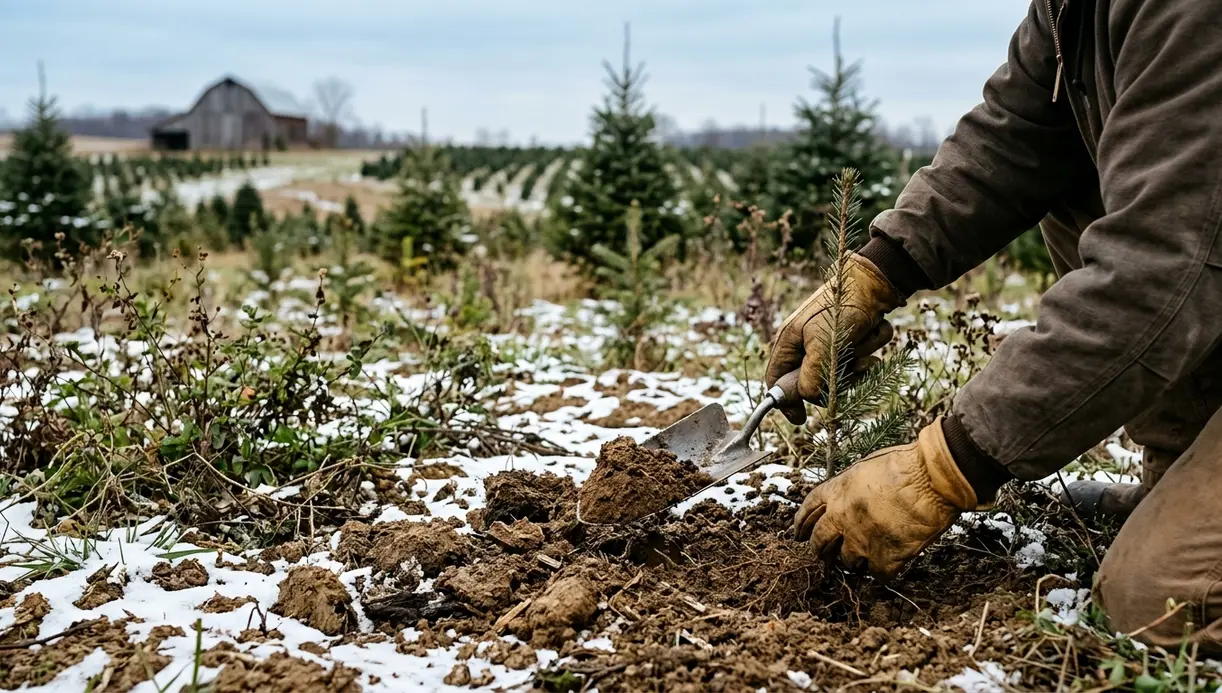
A grower can start with a county soil map, then cross the proposed rows on foot after rain. A probe or spade reveals whether the surface crumb gives way to sticky clay, loose sand, or a compacted layer. Pushing a soil probe into the earth provides immediate tactile feedback. The resistance felt through the handle often indicates a compacted plow pan just below the root zone.
Probe representative rises, midslopes, and depressions 12 to 18 inches deep while the soil is moist enough to hold together. A ribbon that stays long and cohesive when moist suggests appreciable clay. Soil that feels gritty and falls apart quickly points toward a sandier pocket. County soil maps describe useful patterns at planning scale. Inclusions, filled swales, damaged tile, and past grading can make conditions within an individual tree block differ from the mapped unit. Two rows within the same mapped soil unit can behave differently when one crosses an old swale, compacted headland, broken tile line, or sand lens.
Inspect old tile outlets, grassed waterways, wheel ruts, and abrupt vegetation changes because each can expose a drainage boundary missed by a broad map unit. The USDA NRCS Web Soil Survey provides the baseline data for these initial field walks. Record whether water remains between rows at 12, 24, and 48 hours after a substantial rain or rapid snowmelt. Repeated ponding is more informative than one muddy footprint.
Drainage patterns act as the first filter for evergreen roots—standing water after spring thaw contrasts sharply with slopes that shed moisture too quickly. Oney's Tree Farm & Nursery field logs track seasonal saturation, and the pattern holds year to year: prolonged standing water suffocates fine root hairs long before the canopy shows visible stress.
Rainfall Timing and the Moisture Balance Evergreens Need
Moisture decisions rest on the sequence of precipitation. Growing-season rain in the region arrives in bursts and dry stretches. That pattern dictates the success of Christmas tree rows. Crews compare recent rain with root-zone feel, seedling condition, weed growth, and the bearing strength of the lane. Check newly planted root zones several inches below the surface to accurately judge moisture beneath the dark crust or damp mulch.

Lower Stem Bark Protection
Keep mulch away from direct contact with the lower stem, where trapped moisture can conceal bark injury and rodent activity.
During a wet spell, delay tractor entry when tires leave deep, glossy ruts or squeeze water to the surface. Those signs indicate soil that can smear and compact around future roots. Running heavy equipment over saturated clay loams damages soil structure. During a dry stretch, inspect south- and west-facing row edges first because wind and afternoon sun can dry young foliage and planting slits sooner there.
Field maintenance moves tie directly to wet years versus dry ones. Mowing height, weed pressure, and heavy equipment usage all shift based on the immediate moisture balance. Weed growth accelerates rapidly following a heavy summer burst of rain. The competition for moisture during the subsequent dry stretch forces a decision on mowing height to protect the young evergreens.
Snow Cover, Freeze Cycles, and Winter Tree Health
Fall preparation follows the field's exposure. Young trees on an open wind edge require checks for loose root collars and unstable leaders. Rows behind a drift line need inspection for places where heavy snow might settle. Snow around the root zone can moderate rapid temperature swings. Wet snow or an ice crust can pull apart branch whorls and deform a developing top.
Snow cover acts in multiple ways: loose powder shelters roots, while drifted wet snow, crust, or glaze ice can spread branches and damage leaders. An ice crust forming over a deep snowpack creates a rigid layer. As the snow beneath settles or melts, the crust pulls downward on the trapped lower branches, sometimes stripping needles or breaking whorls entirely.
After a thaw-refreeze cycle, inspect newly planted stock for frost heaving that has exposed the root collar or opened a gap around the planting slit. Winter desiccation often appears most clearly on foliage facing prevailing wind or reflected winter sun, especially when frozen soil limits replacement water. Species choice and wind exposure interact heavily with local snow patterns. Late-season nitrogen is avoided when it would encourage soft growth that has little time to harden before freezing weather. Staking young trees and establishing windbreak edges prepare the block for the incoming freeze.
Matching Species and Spacing to the Field You Actually Have
The grower walks the field during spring wetness, marks seeps and ponded strips, and divides the parcel into practical planting zones. Better-drained rises are reserved for Balsam fir and other species that resent saturated ground. Lay out rows so mowers and shearing crews can reach them without crossing the deepest swale or turning repeatedly in a wet headland.
Common field layouts may begin near 6 feet between planting positions and 6 to 8 feet between rows, then widen where tractor clearance, mature crown width, or visitor access requires it. Spacing guidelines give a baseline, but actual row width yields to the turning radius of the mowing equipment on hand. Keep turning space and access lanes out of known seep lines. Repeated traffic can deepen ruts and redirect water into the planted row.
Stage a new planting across two or three spring seasons so survival, leader growth, ponding, and snow drift can be compared before the entire parcel is committed. Staging that way lets the farm read unfamiliar ground first.
Maintenance Rhythms Built Around Local Soil and Seasons
Crews build a field calendar from repeated observations. They note which clay lanes stay soft after rain, which sandy shoulders lose moisture first, where weeds overtop seedlings, and where a winter wind tunnel forms. Scout young blocks before mowing so hidden seedlings, vole runs, standing water, and washouts can be marked for the operator.
Leave a higher grass canopy during hot, dry periods when scalping would expose soil. Prevent weeds from closing over lower evergreen branches and restricting inspection. Building a visual history of the field requires discipline.
Spring Extension Shearing Windows
Schedule shearing after spring extension has become firm enough to hold a cut, adjusting the timing by species and vigor.
Photograph persistent seeps and stressed row ends from the exact same field position in spring, midsummer, and after leaf fall. Repeated views help crews distinguish a seasonal patch from an expanding problem. Long-term tree health relies on repeated small corrections. Fixing a seep or adjusting a wind edge sustains the block. Local farm crews learn a field over years of seasons, building a shared understanding of the terrain.
A Wet Corner After Thaw on a McHenry Tree Row
On a thawing spring morning, a grower steps off the firm lane and sinks into a low strip between last year's seedlings. Meltwater still shines in the planting slits while the row upslope is merely damp. The decision boundary is marked where repeated ponding, soft footing, exposed planting slits, and gray or rust-mottled subsoil occur together. Flags remain through layout so the planter, mower operator, and drainage contractor can see the exact wet strip during dry summer months. The grower ties a bright ribbon to the nearest sturdy branch, marking that specific strip for a tile line or a shift in species before the next planting truck arrives.