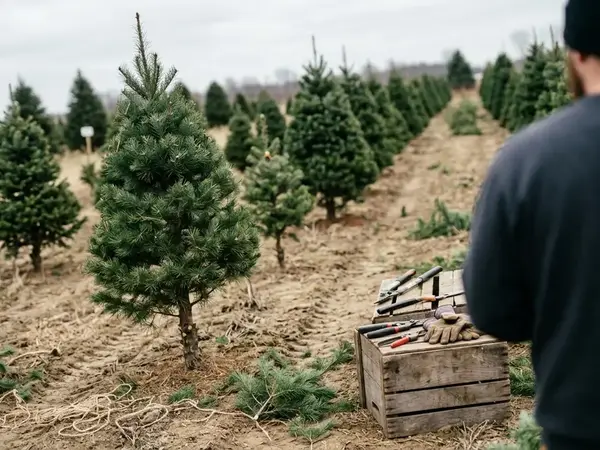


Every December, families walk the choose-and-cut lanes and make a decision in about four seconds: that one, the full one, third row back. The tree looks fine standing in the field. The trouble arrives at home, in the living room, on a stand, with a box of ornaments open on the floor.
Quick Nav
- What a misread tree costs you indoors
- Start mid-branch: bundles, blades, four-sided sticks
- The roll test and the stub left behind
- Cone posture, and the empty fir crown
- Bark blisters, branch spring, and the twenty-foot view
- One crushed needle as tie-breaker
- Running the order aloud in a mixed row
- Pull the needle before you look at the price
What a Misread Tree Costs You Indoors
Confusing fir, spruce, and pine in the row does not stay in the row. It follows you home as needles collecting under the stand, a scent sharper than anyone in the house wanted, branch tips that sag under a glass ornament, or foliage so prickly that decorating turns into a chore with gloves on.
The gain from a thirty-second check is simple to state: you bring home a species that matches how your household actually lives with a cut tree for three or four weeks. Ornament weight, tolerance for sharp needles, fragrance preference. Those are the real specifications, and they are decided by family, not by fullness.
The seven clues below were built for a December lane, not a botany textbook. No hand lens, no dichotomous key, no specimen cut. They work while you are wearing gloves, holding a saw, and keeping one eye on a child who has already run two rows ahead.
Start Mid-Branch: Bundles, Blades, and Four-Sided Sticks
Reach into the middle of a branch, not the sunburned tips at the end of the shoot. Weathered tips read poorly. Mid-branch needles are plump, intact, and honest.
Clue 1 — grouping
Look at where the needles meet the twig. Pines hold their needles in bundles, wrapped together at the base by a papery sheath called a fascicle; those bundles commonly contain two, three, or five needles. Firs and spruces attach every needle individually, one at a time, straight to the twig. This single observation splits the pines away from everything else and it is the fastest split available in the field.
Clue 2 — needle shape
Turn one needle sideways. A fir needle is flat, more like a small blade, and its underside often shows two pale stomatal bands running the length of it. A spruce needle is a four-sided stick, stiff on every face. Inside a pine bundle the needles are long and slender and there is no mistaking them for either.
Locate the needle base, count what shares it, turn one needle to read the profile. That whole sequence takes about ten seconds once you have done it twice.
The Roll Test and the Stub Left Behind
Clue 3 is the roll. Take one loose needle between thumb and forefinger and turn it. A spruce needle rolls willingly, because it has several firm sides to catch. A flat fir needle resists and wants to lie down. Children get this one immediately, which makes it the best clue to hand off.
Clue 4 checks that answer against the tree rather than trusting your fingertips. Look at the attachment point. Spruce leaves a small woody peg standing on the twig, so a spruce twig stays rough to the touch. Fir leaves a smooth, round scar, closer to a tiny suction cup, and a fir twig feels comparatively smooth. Pine keeps that papery sheath at the base of the bundle.
Cold matters here. When wet gloves and numb fingertips blur the roll, the twig surface still answers plainly, and I would rather trust a peg I can feel than a roll I half-imagined.
Needle Etiquette
Use a needle from a lower branch the crew has already trimmed, or one lying loose beneath the tree. Stripping foliage from a display tree teaches less and damages a tree another family may be about to tag.
Cone Posture, and the Empty Fir Crown
Cones confirm; they rarely decide. That is why they sit fifth in the order rather than first.
When cones are present, posture separates the families cleanly. Fir cones stand upright on the branch and frequently disintegrate right on the tree. Spruce cones hang down and usually drop whole. Pine cones are woody, often clustered, and they persist.
Here is the boundary worth carrying with you: on a December Illinois farm walk, fir cones may already have broken apart in the crown, leaving nothing complete for a family to find. An empty fir is not evidence against fir. When no cone turns up, the decision goes straight back to the twig — round scar for fir, peg for spruce.
Search the ground beneath the outer branch spread, then the older wood inside the crown. Fallen material collects under the drip line. Almost nobody finds cones by staring at the photogenic leader at the top, which is exactly where cameras point.
Bark Blisters, Branch Spring, and the Twenty-Foot View
Once the needles have named a likely family, bark and branch behavior serve as a whole-tree cross-check.
- Young fir tends toward relatively smooth bark studded with resin blisters.
- Spruce turns scaly earlier, even at farm-tree size.
- Pine shows plates or furrows on trunks of modest diameter.
Then press a reachable branch gently and let it come back. Fir branches commonly form flexible, shelf-like layers, the kind that carry ornaments without dropping them. Spruce feels stiffer and bristlier under the hand. Pine crowns read more open, because the longer needles gather toward the shoot ends and change the whole outline.
Across the balsam fir blocks at Oney's Tree Farm & Nursery, walked and re-walked every season for years, the family silhouette becomes readable from roughly twenty feet off the row. The close needle check still comes first. These bark and outline comparisons are tuned to cultivated Christmas trees of modest size, so do not carry them unchanged to a forest giant or a mature street spruce, where the trunk tells an entirely different story.
One Crushed Needle as Tie-Breaker
Clue 7 is the one everyone wants to start with. Crush a needle, breathe in, decide. It belongs at the end.
Fir generally leans citrus and balsam with a sweet resin behind it. Spruce comes across sharper, closer to turpentine. Pine smells like the pine closet most of us grew up with. Those distinctions are real, and they also flatten fast in cold air, with a head cold, or simply because two people smell resin differently.
So use fragrance to choose between two trees that already passed the structural checks. Crush a single fallen needle or a clipping from the path. One needle, two fingers.
Running the Order Aloud in a Mixed Row
Find a spot in a mixed row with three comparison points within a few steps: a bundled pine, a flat-needled fir, a prickly spruce. Then run the clues out loud in a fixed order and let the kids supply the answers.
- Bundle or single needle?
- Flat blade or four-sided stick?
- Does it roll or resist?
- Peg, round scar, or papery sheath on the twig?
- Cone posture, if a cone can be found.
- Bark texture, plus how the branch springs back.
- Scent from one crushed needle.
The pine resolves in one step. Fir resolves by step four: single needle, flat, will not roll, smooth round scar.
That third tree is the reason this exercise exists. Dense, symmetrical, beautifully sheared, and it looks like a premium fir from the lane. The needle rolls. The twig shows pegs. It is a spruce, and now the family knows that before the saw comes out rather than while hanging ornaments on stiff, bristly branches.
Seven Clues, One Line
Count the bundle, feel the shape, roll it, read the twig stub, hunt for a cone, flex a branch while you read the bark, finish with one crushed needle.
Pull the Needle Before You Look at the Price
My recommendation, without hedging: do not open your farm walk with price, height, or which tree looks fullest from the parking lot. Open it with one permitted loose needle between your fingers.
A bundle means pine. A needle that rolls, on a twig with pegs, means spruce. A flat needle leaving a smooth round scar means fir. Confirm with scent and branch spring, decide whether that family suits your household, and then tag and cut.
Species first, shopping second. That order costs you half a minute in the row and protects the entire indoor holiday, instead of teaching you about prickliness, weak branch tips, or the wrong fragrance on the night the ornaments come down from the attic.