Quick Nav
- Five Household Objects Can Date a Tree Season
- Reading the Back of a Tree-Farm Snapshot First
- Copying Species and Price From a Saved Tag
- Carbon Slips in the December Bill Stack
- Holiday Cards That Mention the Field or the Variety
- Processor Dates on Slide Boxes and Envelopes
- Labeling the Copy While the Original Stays Home
- Filling In a Label for the Keepsake That Shows a Year
Five Household Objects Can Date a Tree Season
Most family stories about a trip to Oney's Tree Farm & Nursery keep the cold, the cocoa, and the walk back to the car. They rarely keep the year, the species name on the tag, or what the tree cost. Those details often survive anyway, in objects the family already owns and has never read closely.
Five objects do most of this work:
- A dated family photograph
- A saved tree tag
- A carbon receipt or order slip
- A holiday card or note
- A slide box or photo-lab envelope
Each one answers a different question. The photograph shows visible surroundings. The tag preserves species and price wording. The receipt records the transaction. The card keeps the family's own words from that winter. The slide box or envelope carries processing information. Read together, they can connect a remembered Illinois tree-farm visit to a documented year.
The method below follows one sequence for every object: read it, label what is actually there, digitize front and back, and offer a copy if someone wants one. Every date stays attached to its source, whether that is a printed transaction date, a processor stamp, a handwritten caption, or dated correspondence.
One boundary belongs up front. This is a way of reading household keepsakes; it makes no claim to be an official farm history, and it does not assume the farm keeps a collecting archive.
Reading the Back of a Tree-Farm Snapshot First
Turn the photograph over before you study the scene. The back frequently holds the most precise date on the print.
Two kinds of date, recorded separately
A processor stamp and a handwritten caption are different evidence. A lab stamp was applied mechanically when the film was printed. A pencil note reading "Christmas 19—" was written by a person, possibly years later, from memory. Transcribe both, in separate fields. For the caption, preserve the incomplete year exactly as written and record the writer as the family identifies them, or as "hand unknown."
If a lab envelope number appears, copy it exactly, keeping leading zeros and punctuation. That string is what lets you match the print to a surviving envelope later.
What the front can and cannot show
Describe only what sits in the frame: a field edge, a tree beside a child, a tag still hanging on a branch, a wagon, a sales table. Plain terms work best. Resist writing "the north field" unless something in the picture says so.
Faces need care. Keep identifications in a private family record, and use a neutral phrase such as "child beside selected tree" on any label meant for sharing. When you photograph the print, capture the entire front and back, edges included, since stamps and pencil marks often sit right at the border.
Copying Species and Price From a Saved Tag
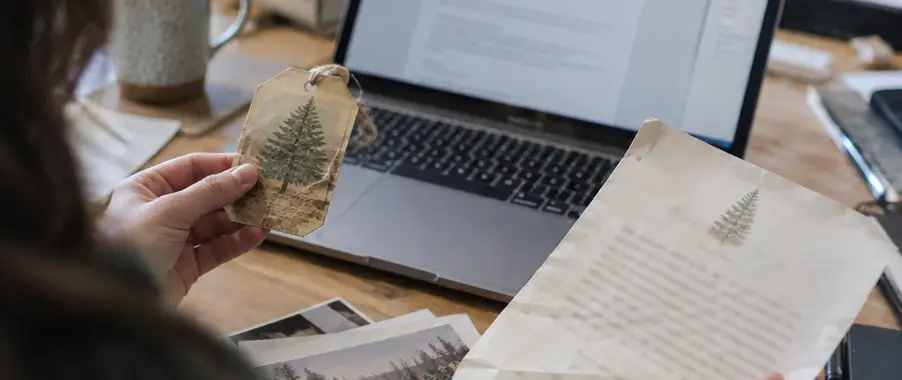
A saved tag is the strongest household clue to what a family actually brought home. It is also the easiest to over-interpret.
Work through it line by line:
- Copy the printed species wording exactly as it appears. If it says "Balsam" or an abbreviation, write that. Do not convert it to a modern name such as Balsam fir unless those words are printed.
- Copy the size line with its units and abbreviations.
- Copy the price with its currency symbol and decimal point as shown.
- Where ink has failed, write [unreadable]. Leave the blank.
Then record the tag as a physical object: card color, string or wire, staple holes, any handwritten additions. Note each as its own observation. If a photograph shows a tag on the tree, compare the attachment. A match helps establish which keepsakes belong to the same purchase.
Missing Letters Stay Missing
Filling a faded price from memory feels harmless at the kitchen table. Once that guess is copied and shared, nobody downstream can tell it from what was printed.
Scope matters here. One tag documents one sale to one household. It says nothing about the season's inventory or what a typical tree cost that year.
Carbon Slips in the December Bill Stack
Families filed things where they filed things. A carbon slip from a tree purchase might be folded into tax papers, tucked inside a church program, or sitting in the December bill stack. Check all three.
When you find one, copy these fields if they are readable:
- Date
- Tree description
- Amount, with subtotal, tax, and total under their own headings when the slip shows them
- Any handwritten note
- A partial seller line, letter for letter, with the missing portion marked [unreadable]
Carbon writing fades unevenly. Photograph it in even light, then zoom in on the image and confirm the smallest readable marks still show.
On price and date, a receipt outranks a retold story. Use its entries for the purchase-date and price fields, and keep the family's version separately with the speaker named. Both are worth having; they answer different questions. The receipt still describes only that one transaction.
Strip the Account Lines
Before any copy leaves the house, remove account numbers, payment-card digits, phone numbers, and street addresses from the shareable duplicate. The original goes back into the family's papers untouched.
Holiday Cards That Mention the Field or the Variety
Cards and letters carry something no tag can: the voice of someone who was there. A single sentence might mention a muddy lot, a named variety, a particular field, or which uncle insisted on the tallest tree.
Keep the transcription light. Choose the passage that actually concerns the outing and quote only that. Retain the original tone and punctuation, even when it rambles. Mark an uncertain word as [unclear] and keep the readable words around it.
Two dates may compete. A date written inside the card belongs to the writer; a postmark belongs to the envelope and the mail. Record them as separate fields.
Permission travels with the excerpt. Before sharing a living person's identifiable name or private remark, ask them. For a child's identifying details, ask a parent or guardian. Write the decision beside the excerpt so it stays attached to every copy.
And the scope: one card is one household's wording. It is neither a farm slogan nor evidence that every visitor had the same afternoon.
Processor Dates on Slide Boxes and Envelopes
Read the container before touching what is inside. Box order is evidence, and it disappears the moment slides get shuffled for a projector night.
From the box or envelope itself, record:
- Lab wording, if printed
- Processing month and year, in the format shown
- Printed frame count
- Number of slides actually present, as a separate figure
- Any family writing on the lid
Label the lab's date explicitly as processor date. Film often sat in a camera for days or weeks before development, so the stamp tells you when processing happened. Treating it as the cut day would be a guess.
Keep frame numbers and box order intact, gaps and empty positions included. If a slide shows a tree lot, tie it to its frame position and the container record, and describe what is visible. When a mount is blank, enter "mount date: blank" and put the box's dated information in its own field. A blank mount should never inherit an invented year.
Labeling the Copy While the Original Stays Home
Every object above ends in the same routine. I keep it deliberately repetitive so that a photo back and a carbon slip get labeled with identical fields.
- Write the label line in this order: object type; readable text; printed or stamped year; handwritten date and writer, if present; family holder nickname (never a child's full name); sharing permission.
- Separate observation from interpretation. Use two fields: "read on object" and "family interpretation."
- Photograph in even light, front and back, the whole object visible.
- Name the files by object type, documented year, and side: object-type_YEAR_front and object-type_YEAR_back. Use undated where no year is printed or stamped. Keep people's names out of filenames entirely.
- Keep two images: an unaltered household version and a separate redacted sharing version.
- Ask before sending. Secure permission from recognizable people or the appropriate guardian, then ask the intended recipient whether a copy would be useful. Do not assume Oney's Tree Farm & Nursery accepts donations or wants the object.
The Copy Is the Gift
A labeled copy with its blanks preserved is the useful thing to offer. The family keeps the original.
Filling In a Label for the Keepsake That Shows a Year
Start with whichever object already carries a readable year. Fill this label from that object in your hand:
Object: ____; Readable words: ____; Year as shown: ____; Year source (stamp, print, or handwriting): ____; Holder nickname: ____; Copy offered: ____; Sharing permission: ____; Original stays home: ____.
If the year is handwritten, add "Writer: ____" and keep any uncertainty in the date exactly as it appears.
Now one pass, start to finish. Pick up the item. Copy only the letters you can see. Mark each unreadable spot. Photograph the front, then the back. Open both image files and confirm the complete object shows in each. Then put the original back in the drawer, box, or album where the family keeps it.
So which one is it in your house: the stamp on a photo back, the wired tag, the carbon slip, the card, or the slide box lid?