What Readers Risk Missing About Farm Heritage
Most people meet a tree farm in December, saw in hand, kids arguing over height. That version of the story starts too late.
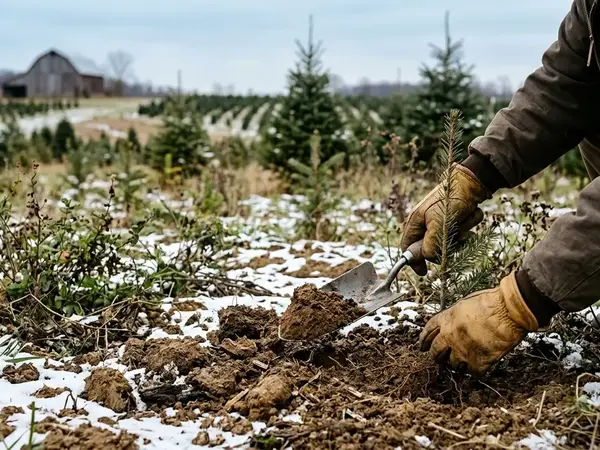
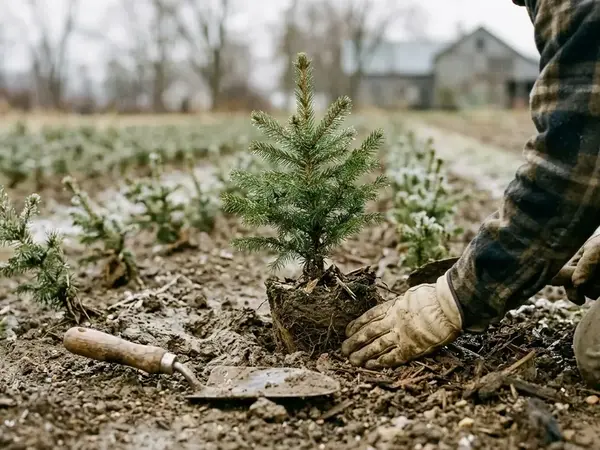
The heritage of a Woodstock tree farm begins with a land-use decision, not a holiday memory. Someone chose to keep acreage in agricultural use rather than sell it off or convert it. Seedlings went into the ground years before the first family ever walked a row. In northern Illinois, Christmas tree blocks commonly take 7 to 10 growing seasons before a tree is ready for family cutting. That gap matters. The tree a child cuts this year reflects a planting choice made when that child was a toddler.
Misread the origins and you misread the whole legacy. People assume the tallest trees mark the first planting. They rarely do. Older trees are just as likely to be windbreaks, holdovers, or specimens nobody bought.
There is a second thing readers skip: the visible season is compressed into the Thanksgiving-to-Christmas window, while planting, mowing, pruning, and replacement decisions happen across spring, summer, and early fall. What looks like a six-week business is really a year-round operation wearing a holiday coat.
This connects directly to how Illinois land gets used and kept. A field held in Balsam fir production is a field not paved, not row-cropped into exhaustion, not subdivided. The family tradition and the land decision are the same story told from two angles.
Challenges in Sustaining the Woodstock Operation
Slow trees, fast markets. That tension runs under everything at a place like Oney's Tree Farm & Nursery.
A field that looks tidy in December has already survived a difficult year. Woodstock-area farms contend with northern Illinois freeze-thaw cycles, spring saturation, and drying winter winds, all of which can affect seedling survival and needle condition. Wet spring ground means you can't get equipment into low blocks when the weeds are climbing. Winter wind can brown out an otherwise sellable tree along an exposed edge.
Land and Climate Pressures on Tree Growth
The land doesn't behave uniformly. Low pockets hold water. Exposed edges take the wind. Heavier soils shift which species even survive there. A row that thrives near a windbreak may struggle fifty feet out in the open.
This is why a single farm-wide plan tends to fail. The field argues back, block by block.
Shifting Family Labor and Market Demands
The other pressure is human. Family labor changes across generations. Someone who pruned every summer for decades eventually can't, and the next person has to learn the shaping window fast. Annual shaping decisions typically fall between late June and early August, depending on species and growth stage. Miss that window and a tree can be left unsuitable for the same season's sales. There is no makeup date.
Markets shift too. Families ask for different species by name in different decades. The farm has to plant for a demand it can only guess at 7 to 10 years out.
Preserving Original Planting Methods

Then there's the quiet challenge: keeping the original methods legible. Spacing, row orientation, replacement logic. When those live only in one person's head, they blur. A retired planter remembers the pattern; the paperwork often doesn't.
Practical Decisions That Shaped the Farm
The workable strategy was to stop treating the farm as one uniform field and start treating it as a set of small blocks. That single reframing changed how every later decision got made.
With blocks, the family could compare directly. Which rows handled wet ground. Which species held color into December. Which trees families kept walking past year after year. You can't run that comparison on a field you think of as a single thing.
Adaptations to Soil and Species Selection
Species selection followed the ground rather than the catalog. Where a low pocket drowned one planting, a hardier choice went in next. Where wind burned needles, the layout adjusted. This is slow, unglamorous work, and it's the real content of heritage — the accumulated record of what the land accepted.
Community Partnerships for Continuity
No family sustains a tree operation alone across generations. Continuity leaned on relationships: seasonal help during the December weekends, neighbors who understood field access, buyers who came back. These partnerships don't show up in a ledger, but they're why the lights stay on when the labor pool inside one household thins out.
Record-Keeping That Protected Heritage Practices
Here's where the heritage either survives or evaporates. Useful farm records identify block, row, planting year, species, and replacement notes — not merely the number of seedlings purchased. A count tells you what you bought. A row map tells you what you have.
The link that matters most connects spring planting notes with December observations: which rows were easy to access, which trees were repeatedly passed over, which species families requested by name. One season's data feeds the next planting.
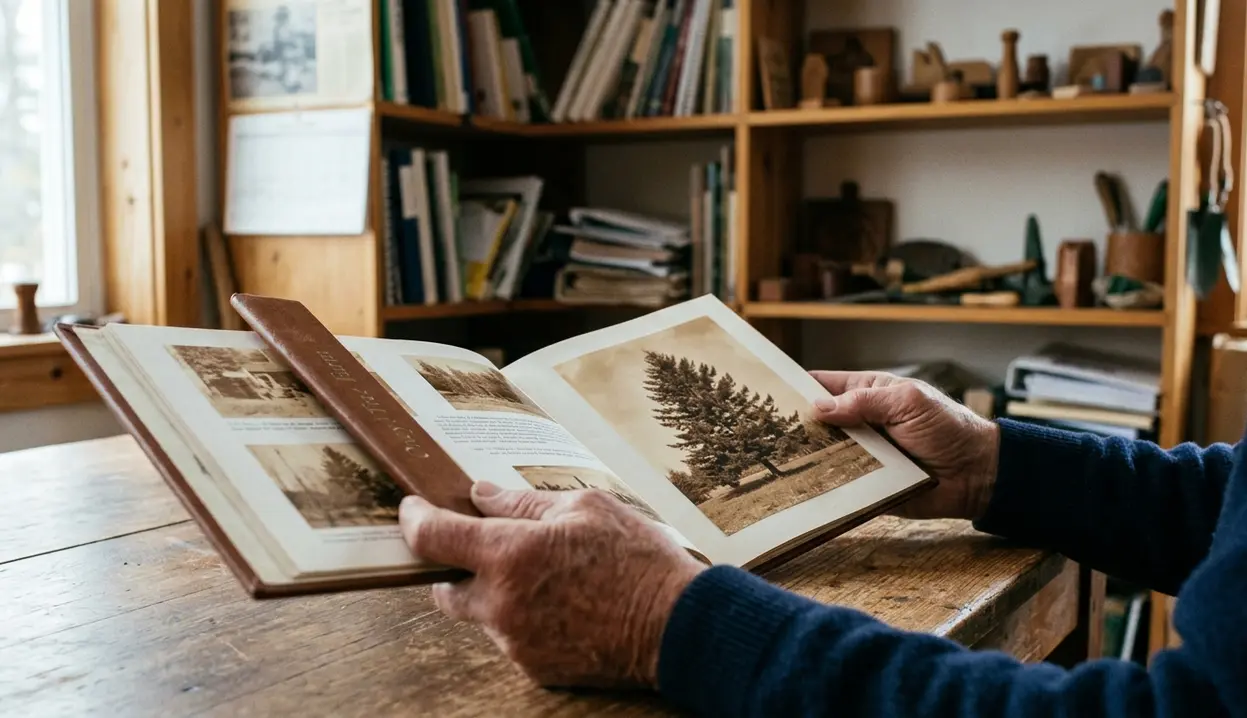
The strongest heritage claim depends on comparing family records, dated photos, row maps, and living field evidence. Oral memory alone can blur planting years and row origins, no matter how confident the retelling.
Farm Heritage Evidence Checklist
- Locate a dated planting ledger or nursery invoice that can be tied to a specific field block.
- Mark the oldest surviving row on a current field map using permanent landmarks.
- Compare old family photographs with present-day rows to confirm layout, not just memory.
- Record species by block so replacement choices stay legible to the next generation.
Outcomes That Define the Farm Today
The farm's identity comes from repeated cycles, not one founding milestone.
Consider the full arc. A production cycle can include spring planting, first-year watering or weed control, several summers of mowing and shaping, pre-season tagging or field checks, harvest, stump removal, and replanting. Run that loop enough times and you get a farm. Each turn of the loop replaces weak spots and moves the next rotation forward.
Long-Term Tree Stock Viability
Viability isn't a stock of trees standing today. It's the pipeline: seedlings at every stage of the 7-to-10-season rotation, so December never runs dry. A farm that plants only when it sells is a farm one bad season from empty rows.
Continued Family Operation Across Generations
The clearest outcome is simply that the operation stayed in the family and stayed in production. That continuity is the heritage claim, more than any single old tree. It means the block system, the shaping calendar, and the row maps got handed down and used.
Role in Local Holiday Traditions
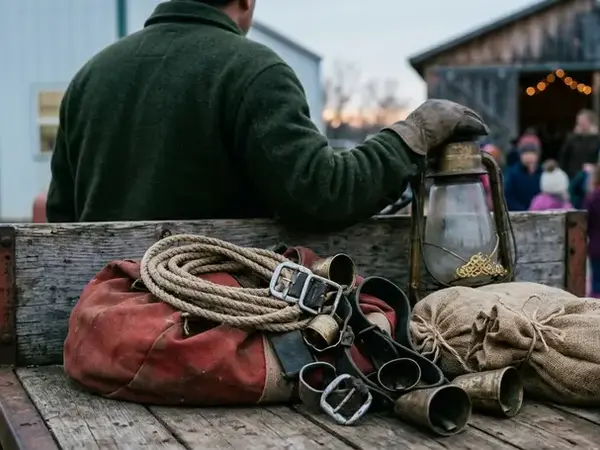
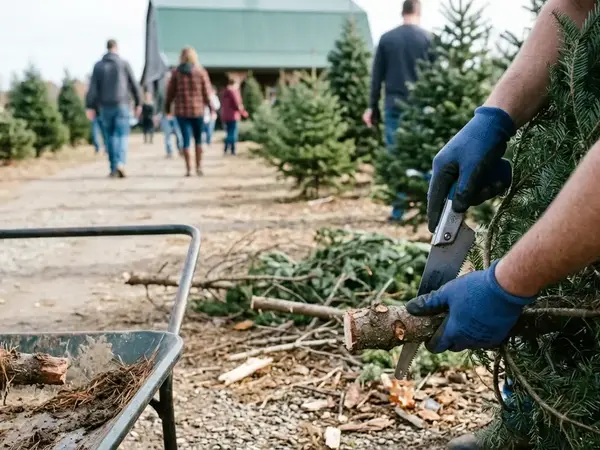
Local holiday use concentrates on late-November and December weekends. That compression makes field access, parking flow, saw safety, and staff coverage part of the farm's heritage practice — not just customer service. How a family moves hundreds of visitors through wet lanes safely is itself an inherited skill, refined over many Decembers.
A Single Detail That Changes the View
Walk the field with someone who knows it, and ask them to point to the oldest surviving original planting row. That one row reorganizes the whole visit.
It has to be identified by fixed references — an old lane, a windbreak, a drainage edge, a barn-facing orientation, rather than a memory-based label. A row you can locate on the ground is evidence. A row you can only name is a story.
What makes it powerful is its living connection to the current harvest. Adjacent replacement rows enter the 7-to-10-season rotation while the older row preserves the original layout logic for mowing lanes, customer walking paths, and replanting alignment. The original planting isn't a museum piece off to the side. It's the reference line that still tells the mower where to turn.
So here's the detail that changes everything: the path a family walks to cut a Balsam fir this December likely traces a lane laid out by a planting row put in the ground 7 to 10 seasons ago — or longer, and that row is still setting the angle of every new seedling planted beside it.