Quick Nav
- What a Mismatched Tree Costs on the Drive Home
- Tree Numbers and Vehicle Numbers, Taken in the Lot
- Sedans: Trunk, One Folded Seat, Then a Mounted Rack
- SUVs and Crossovers: The Hatch Has to Latch
- Pickups: Bed Length and the Tip That Trails Behind
- Netting Narrows the Tree, Straps Hold It
- One Last Walk Along the Bumper
What a Mismatched Tree Costs on the Drive Home
A tree longer than the closed cargo area causes a predictable set of problems. A closing hatch can shear the tip. The hatch may have to stay open for the whole drive. Branches can cover brake lights, and an unsecured trunk can shift forward when you brake hard at the first stop sign out of the farm.
None of this has to happen. A family that measures in the lot keeps three things. The Balsam fir they walked the rows to choose arrives home whole, with its leader intact for the star. The driver still has a usable rear view. And nobody discovers the mismatch after the saw has gone through the trunk, when the tree belongs to them and the vehicle still cannot carry it.
The fit check covers more than whether the tree goes in. It also covers the lights, the license plate, and the driver's sightlines. A tree that technically sits inside the vehicle but blocks the mirror has failed the check.
Tree Numbers and Vehicle Numbers, Taken in the Lot
I work through the measurements in a fixed order. Doing it this way keeps a family from judging fit by how big the vehicle looks from outside. A tall SUV can have a shorter cargo floor than a modest wagon, and only the tape shows that.
On the tree, before anyone kneels with the saw
- Cut-to-tip length. Measure from where the cut will fall to the top of the leader. Every later comparison uses this number.
- Widest branch span. Measure across the fullest lower whorl, usually a little above the cut.
- Baled span. Ask farm staff how narrow the bundle will be once it goes through the netting. Baling pulls the branches inward. The height stays exactly the same.
On the vehicle, with every lid you plan to close
- Sill width. Measure the narrowest point the bundle has to pass through at the rear opening.
- Opening height. Measure the clear height of the hatch or trunk opening.
- Closed cargo length. Measure from the seatbacks or trunk wall to the inside face of the latched lid. Do not measure to the lid swung open. The extra air beneath a raised hatch disappears as soon as you close it.
Count the roof only when a rack is already mounted on it. Then compare the tree's weight with the cargo and roof-load limits printed in that vehicle's own manual. A fresh-cut fir holds a good deal of water. Its weight is the figure people most often guess at instead of checking.
Closed-Lid Boundary
Measure with the hatch shut, or at least to the point where its inside face will sit when latched. A length taken with the lid open will always make the cargo area seem longer than it is.
Sedans: Trunk, One Folded Seat, Then a Mounted Rack
For a sedan, run three tests in order. Stop at the first one where the tree rides securely, the trunk lid latches, and the driver can see.
- Seats up. Compare cut-to-tip length with the distance from the trunk wall to the closed lid. Most trees will not pass this test. The ones that do are usually tabletop trees.
- One rear seat folded. Fold only a seat nobody needs for the ride home. Measure the continuous path from the trunk, through the seat opening, into the cabin. Check where the tip ends up. If it presses against the rear glass, or the branches fill the cabin so the driver cannot see past them, the interior fit has failed.
- A rack that is already mounted. If the car has crossbars installed and rated for the load, the roof becomes an option. Check the weight limit in the manual first.
Two arrangements show up in the lot every season and fail every time. A bare roof is a painted panel with no fixed points to tie to, so it gives you nowhere to secure a tree. A trunk tied half-shut with the trunk sticking out is a failed fit too, however much twine holds it down.
SUVs and Crossovers: The Hatch Has to Latch
Start the SUV check by counting who rides home. Fold only the rear seats nobody will sit in. Every passenger needs an open seating position and a seat belt after the tree is loaded. If the tree takes someone's seat, it is too long for this trip.
Leave the front seats in their normal driving positions. Then measure from the backs of the front seats to the inside of the closed hatch, and allow for the room the bundled branches take up along the sides. Lower the hatch gently to test whether it latches. Do not use it to push the tip into place. If the hatch only closes by bending the leader, the tree is too long.
A tree that fits only with the hatch latched open has failed. So has one whose branches cover the rear window. A helper waving you out of the parking row can guide you for the first twenty feet, give or take. That helper is not in the car when you merge onto Route 47 and need the mirror.
Plan for the cabin as well. Spread a tarp or old sheet across the cargo floor and folded seatbacks before the tree goes in. Balsam fir sap is sticky and needles work into carpet seams. A family should decide in the lot whether that cleanup is acceptable in the car they drive every day.
Tarp Down First
Lay the tarp before you lift the tree. Once the bale is inside, the tarp cannot be slid under it without dragging the needles across the upholstery.
Pickups: Bed Length and the Tip That Trails Behind
A pickup looks like the obvious answer. Its bed still has a fixed length, though, and you need to measure it.
Compare the tree with the bed while the tailgate is up, and measure usable length in the tailgate position you will actually drive with. Lowering the tailgate adds supported length only if the tree is tied so it cannot slide backward over the edge. A tree resting loose on a lowered tailgate is just waiting for the first hill.
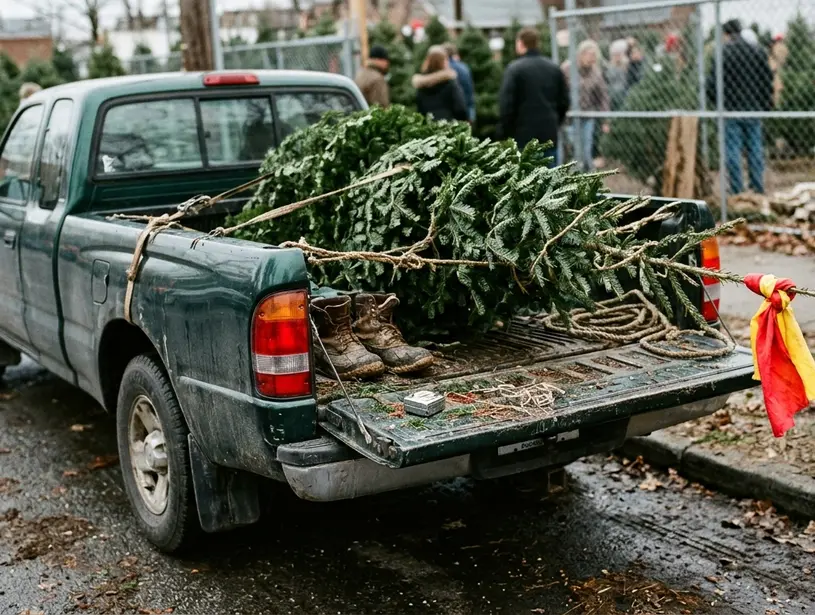
If part of the tree sticks out past the bumper, keep that end easy for following drivers to see. Tie a bright cloth securely to the tip. Then step back and check that neither the tree nor the cloth covers the brake lights, the other rear lamps, or the license plate.
The case that most often ends with a different vehicle is a short-bed truck paired with a tall tree. An open bed can make it seem as though length no longer matters. When the overhang grows long enough that the tip sags or blocks the plate, a longer bed or a different tree is the honest solution.
Netting Narrows the Tree, Straps Hold It
Baling controls width only. Farm netting or twine draws the branches in so the bundle can pass through a hatch the full spread would never clear. The cut-to-tip length stays exactly the same. Netting can solve an opening problem and leave a closed-length problem untouched. After baling, check the bundle against the opening again, and compare the length with your closed-cargo figure once more.
The bale is not a restraint. Secure the tree itself to fixed attachment points meant for the job:
- bed hooks and cargo tie-downs in a pickup or SUV
- trunk tie-down loops in a sedan
- rack attachment points on mounted crossbars
Keep straps off bare paint. Do not run twine through a door and then slam the door on it, because door seals will not hold a load. When you finish, check four things. The tree cannot slide, nothing drags, no light is covered, and the driver's view is clear.
The vehicle manual decides which attachment points and load limits apply, including whether rack feet may be used for securement. A handle or hook that looks convenient may not be rated for a strap, so check the manual before tying to it. Recheck strap tension a few miles down the road as well. Cold, compressed branches settle and the bounce of the road loosens a fresh bale faster than most people expect.
Stop After A Few Miles
Find a safe pull-off shortly after leaving the farm and tug on each strap. Tightening a loose strap there takes a minute. A shifted tree at highway speed is a much bigger problem.
One Last Walk Along the Bumper
The decision is simple. If the tree is longer than the closed cargo area, and there is no rated rack mounted and no bed that holds it securely, do not cut that tree for this vehicle.
You have two good choices in the lot. Pick a shorter tree that clears the tape, or ask the staff to hold your chosen tree until someone brings a longer vehicle. Either way the family still gets a good tree, and the selection they made among the rows is not wasted.
Set the vehicle up the way it will travel, with the seats your passengers need in place, the lids closed, and any rack already installed. Then stretch the tape out on the ground beside the rear bumper to the full cut-to-tip length of the tree you have tagged. Walk that length once against your closed-cargo number. Hand the saw over only when the tape shows the tree fits.