Are the Yellow Needles Inside This White Pine a Fall Shed?
Are the yellow needles inside this eastern white pine a normal autumn shed, or a warning before the saw comes out? In an Illinois choose-and-cut row in fall, families walking the turf aisles often pause when they part the soft outer branches of an eastern white pine and spot a bright band of gold deep near the trunk. A shopper used to the dense, uniform interior of a balsam fir can easily misread that sudden flash of color inside a pine crown.
Judging the tree accurately requires looking directly into the interior structure of the crown rather than evaluating only its green exterior shell. Before unstrapping a hand saw or tagging a trunk for harvest, a careful field check comes down to three observations in order: locating where the yellow sits within the canopy, identifying which needle age class is changing color along the stem, and confirming the mechanical condition of the remaining crown.
Separating routine seasonal senescence from physiological decline protects the buyer from bringing home a stressed tree that will drop its outer foliage indoors. Looking at shoot anatomy, whole-block patterns, and the feel of the twigs themselves gives anyone walking the field enough to make a clear harvest decision.
Where Each Year of Needles Sits on the Branch

Understanding conifer foliage retention begins with the linear geometry of a single branch. If you follow an eastern white pine shoot from its outer tip back toward the branch union, the foliage is arranged in strict chronological order. The newest needles cluster tightly at the terminal tip growth, where the shoot elongated during the most recent growing season. Older needles sit farther back along the woody stem, positioned progressively deeper inside the shaded interior of the crown.
An evergreen shoot carries several overlapping needle age classes at once, holding onto prior seasons' growth while pushing new fascicles at the perimeter. Because conifers do not keep individual needles indefinitely, the tree systematically retires its oldest foliage once those shaded inner needles become less photosynthetically efficient.
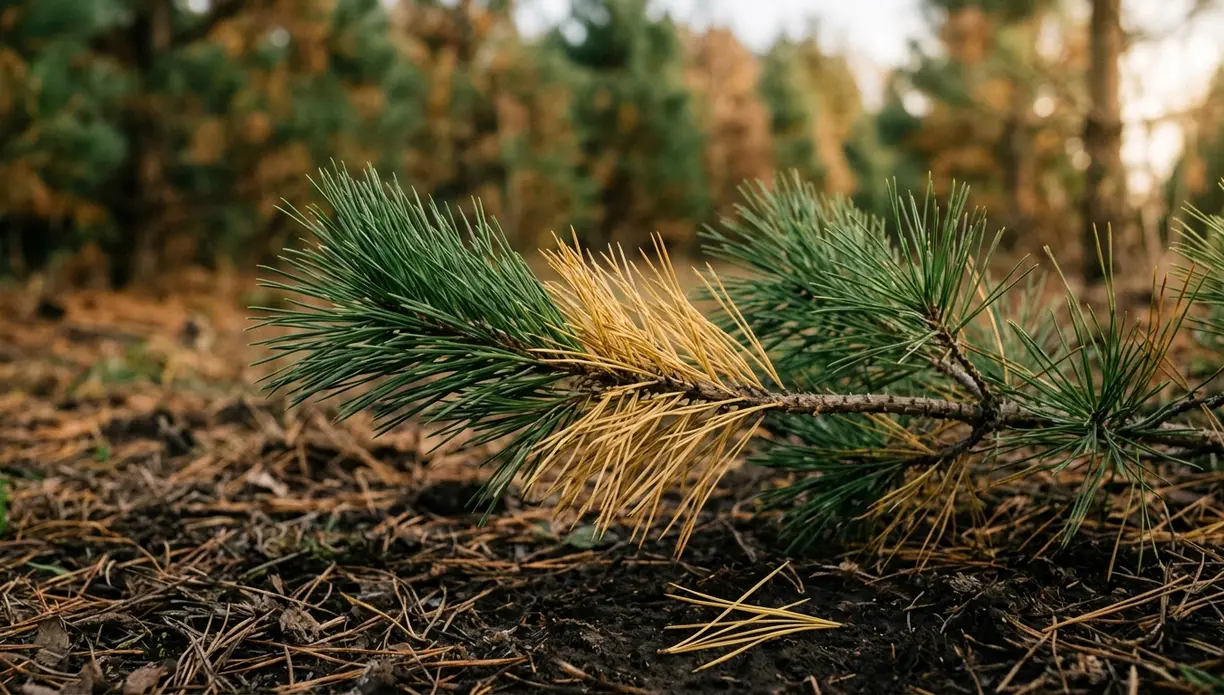
Autumn is the physiological window when this retirement becomes visible. During the fall shed, the oldest interior needles lose their chlorophyll, shift from green to yellow and eventually to a muted straw tone, loosen at the fascicle base, and drop from the twig. Throughout this process, the outer shell of newer growth remains vibrant green and firmly attached. Recognizing this spatial separation along the axis of the shoot is the foundation for diagnosing any discoloration in the field.
The Even Yellow Band Inside a Healthy Crown
When seasonal shedding gets underway across a plantation, the visual signature is fairly consistent from tree to tree. Looking across the interior of a healthy crown reveals a broadly even yellow or gold band confined to the inner foliage, paired with a dense, uninterrupted green outer shell all the way around the tree. Stepping back to scan the surrounding rows provides quick confirmation: normal autumn shedding typically appears on many eastern white pines in the same planting block during the same seasonal window.
The ground beneath the canopy offers a second piece of corroborating evidence. Under the branches around the drip line—the perimeter of soil directly beneath the outer reach of the limbs—you'll usually find a loose scatter of fallen yellow and straw-colored needles. When this litter accumulates under a crown that still maintains a full, lush green exterior, the pattern fits normal seasonal shedding.
Seasonal Shed Signatures
White-pine shoot breakdown: green current-season tip → older yellow interior needles → loose straw needles beneath the drip line. In a healthy autumn shed, the interior color stays a clean yellow to straw, free of red-brown spotting or distinct bands across individual needles.
Handling the outer canopy rounds out the picture. On a tree undergoing routine inner-needle drop, all branch tips and current-season foliage remain uniformly green, and small live twigs stay supple and flexible around the entire circumference of the crown.
When Yellow Moves Out to This Year's Tips
The diagnosis shifts immediately if you trace discolored needles outward along a lateral branch and find them occupying the shoot tip. Yellow, brown, or straw-colored foliage on the current season's tip growth falls outside the normal oldest-needle autumn shed pattern and changes what to do: leave that tree standing in the row and move on to another candidate.
Disease or environmental stress leaves structural clues that look quite different from the symmetry of natural senescence. While inspecting the exterior of the canopy, watch for these field indicators:
- Asymmetrical canopy loss: One-sided thinning where a single sector of the crown appears sparse while the opposite face remains full.
- Attached dead foliage: Needles that turn brown in place and remain hanging on the shoot rather than loosening and dropping cleanly to the ground.
- Woody tissue failure: Dead, brittle terminal twigs scattered among the outer branches.
- Stem lesions: Bark wounds, sunken cankers, or pitch weeping directly from undisturbed bark along the trunk or main scaffold limbs.
Block-level context matters just as much when evaluating abnormal discoloration. If a single eastern white pine is yellowing and thinning while its immediate neighbors in the same row stay dark green, or if heavy yellowing appeared well before autumn arrived, the tree is experiencing localized stress rather than a calendar-driven shed. In landscape or production plantings, those symptoms warrant leaving the tree uncut and consulting someone who diagnoses landscape conifers before applying any treatment.
White Pine Lot Checks Before the Saw Comes Out
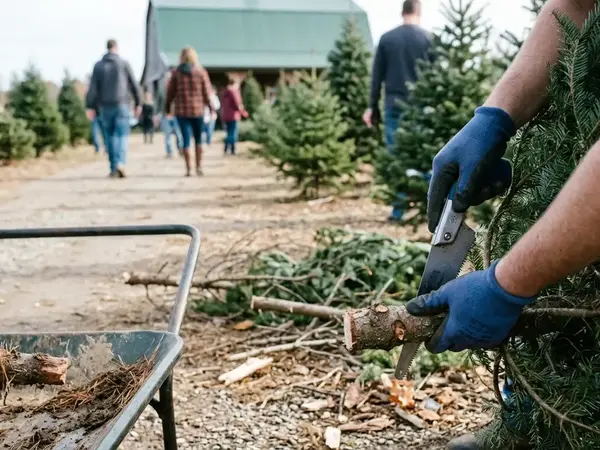
Before committing to a specific tree on a choose-and-cut lot, run through a quick physical inspection around the full perimeter of the plant. Many shoppers evaluate only the south or lane-facing side of a tree, missing defects hidden on the back face where neighboring crowns crowd the row.
- Circle the entire perimeter: Walk completely around the tree, inspecting the back and sides with the same scrutiny applied to the front face toward the walking lane.
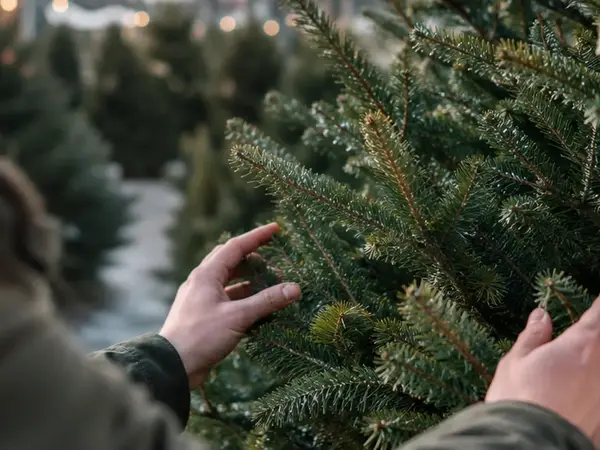
- Part the outer shell: Gently separate the outer green branches at chest height to view the interior stem structure, confirming that any yellow color is strictly confined to older interior needles and that current-season tips remain green all the way around the crown.
- Test twig flexibility: Select a small lateral twig on the outer canopy and bend it gently between your thumb and forefinger without forcing a break; a live, hydrated twig flexes smoothly, whereas a compromised twig snaps dry.
- Perform a gentle branch shake: Lightly shake a mid-crown limb and watch what drops; a few loose older interior needles falling out fits seasonal shedding, whereas a shower of green tip needles signals a problem.
- Differentiate pitch sources: Check the trunk and lower limbs for resin flow, keeping in mind that fresh, clear pitch beading at an existing fresh pruning cut is a normal wound response, unlike heavy pitch weeping from a sunken bark canker.
Tip Color Boundary
The choose-and-cut color boundary: yellow behind green tips fits autumn shedding; yellow reaching this year's tips stops the selection.
When the interior cannot be seen clearly because of tight shearing, or when healthy and concerning patterns are mixed on the same plant, the lot inspection does not establish a clear seasonal-shed pattern; leave that tree and choose another with a clearly healthy green exterior. A careful walk-around takes the guesswork out of the lot, so the tree you harvest brings vigorous, well-hydrated outer foliage indoors.
Read One Crown, Then Decide
To try this in the field, stand beneath the outer edge of one eastern white pine's crown and select a single mid-crown branch at eye level. Hold the terminal end lightly in one hand and trace the shoot backward from the green tip toward the trunk, watching exactly where the needle color changes along the wood. Compare those outer green tips against the rest of the limbs on that same crown, then glance across the aisle to compare them with nearby white pines in the block.
If the yellow color begins only among the older interior needles farther back on the shoot, the outer tips are flexible and green all the way around, and the pattern matches the surrounding block, the tree fits a normal fall shed and is a fair Christmas-tree choice. If yellow or brown discoloration reaches the current season's tips, or if one side of the crown is noticeably thin, set that tree aside and walk down the row to the next candidate. When you part the branches on the next eastern white pine down the line, does the yellow stop behind a full ring of green tips, or does it reach the outer growth?